Installation
Standard Procedure
The standard way to get HiggsDNA up and running consists in the following steps.
After cloning the repo and accessing it with the usual:
git clone https://gitlab.cern.ch/cms-analysis/general/HiggsDNA.git
cd HiggsDNA
one can create a conda environment with the main needed dependencies. We recommend accessing conda through Miniforge as it is a minimal conda installer that only installs conda-forge packages by default. After instaling Miniforge, you can create the environment with the following commands:
# We recommend python 3.11 but in principle, 3.10 and 3.9 are fine too.
conda create -n higgs-dna python=3.11 xrootd
# You can also use mamba instead of conda, which may be faster but the latest
# miniforge releases use mamba as the default solver anyways so there is no benefit.
mamba create -n higgs-dna python=3.11 xrootd

conda activate higgs-dna
To install the package in editable mode run:
pip install -e .[dev,test]
Docker & Singularity
In case you experience issues using the conda environment, docker images are available to try. These are especially useful on LXPLUS, where instead of docker the singularity command should be used (also called apptainer).
Since the main goal of the Docker images to use on LXPLUS it to ease the experience of submitting jobs using Dask, the base image used is the one provided with the dask-lxplus package (as can be seen in the Dockerfile).
Docker images are built in CI every time a commit is pushed on the master branch, with the most recent one tagged as latest.
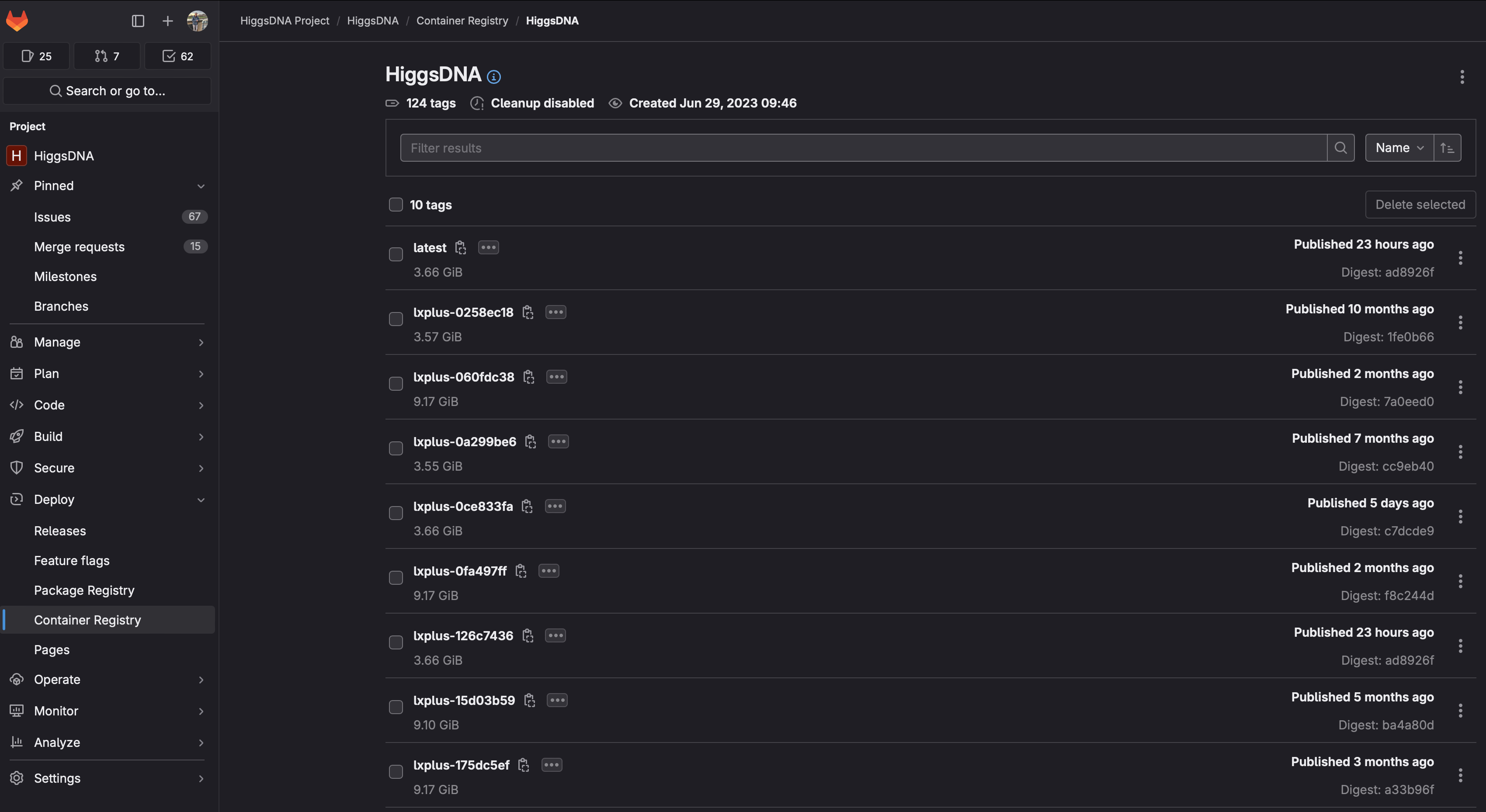
If you want to use the latest image with HiggsDNA already installed in it (i.e. no development), you can pull it with:
apptainer shell -B /afs -B /cvmfs/cms.cern.ch \
-B /tmp  -B /eos/cms/ \
-B /etc/sysconfig/ngbauth-submit -B ${XDG_RUNTIME_DIR} --env KRB5CCNAME="FILE:${XDG_RUNTIME_DIR}/krb5cc" \
/cvmfs/unpacked.cern.ch/gitlab-registry.cern.ch/cms-analysis/general/higgsdna:latest
If you want to also develop you can pull the same image and create a virtual environment inside it:
# pull and access the image
apptainer shell -B /afs -B /cvmfs/cms.cern.ch \
-B /tmp  -B /eos/cms/ \
-B /etc/sysconfig/ngbauth-submit -B ${XDG_RUNTIME_DIR} --env KRB5CCNAME="FILE:${XDG_RUNTIME_DIR}/krb5cc" \
/cvmfs/unpacked.cern.ch/gitlab-registry.cern.ch/cms-analysis/general/higgsdna:latest

# create virtual environment
python -m venv --system-site-packages myenv

# source environment
source myenv/bin/activate
You can then access your HiggsDNA repository and install it in editable mode:
cd HiggsDNA
pip install -e .[dev,test]
One known issue of this procedure is in the installation of xgboost. If you see something like:
xgboost.libpath.XGBoostLibraryNotFound: Cannot find XGBoost Library in the candidate path.  List of candidates:
- /afs/cern.ch/work/g/gallim/devel/myenv/lib/libxgboost.so
XGBoost Python package path: /usr/local/lib/python3.8/site-packages/xgboost
sys.prefix: /afs/cern.ch/work/g/gallim/devel/myenv
See: https://xgboost.readthedocs.io/en/latest/build.html for installing XGBoost.
if that happens, you can create a symlink to the shared library already provided in the image, e.g.:
ln -s /usr/local/lib/libxgboost.so /afs/cern.ch/work/g/gallim/devel/myenv/lib/libxgboost.so
Older versions of the images are also available here.